

How is the French nuclear fleet doing at the moment? What are the future projects envisaged within the industry? We take stock of the challenges, issues and future projects within the French nuclear fleet.
How is the French nuclear fleet doing at the moment?
With 3,000 companies and 220,000 employees, nuclear energy is a major sector of the country’s industry. It is indeed a question of the third largest industrial sector in France and the leading source of electricity consumption and production on a national scale.
Currently, the French nuclear power fleet consists of 56 generation 2 pressurized water reactors (more commonly known as “EPR reactors” or “ERP” – European Pressurized water Reactor). The power levels of these nuclear reactors range from 900 MW (equivalent to the electricity consumption of about 400,000 homes) to 1,450 MW. These nuclear facilities are located throughout the country.
What is the number of nuclear power plants in France in 2022?
There were 18 nuclear power plants throughout France in 2022 since the shutdown of the Fessenheim nuclear site, whose reactors are being dismantled.
What is the location of nuclear power plants in France?
Here is the list of nuclear power plants in France and their location:
- Gravelines,
- Penly,
- Paluel,
- Flamanville (Flamanville’s public buildings are spread over two different nuclear power plants – in 2022, four new steam generators were installed in one of the reactors),
- Chooz,
- Cattenom,
- Saint-Laurent-des-Eaux,
- Dampierre,
- Nogent-sur-Seine,
- Chinon,
- Belleville-sur-Loire,
- Civaux,
- Blayais,
- Bugey,
- Saint-Alban,
- Cruas,
- Tricastin,
- Golfech.
Here is the map of nuclear power plants in France in 2022:
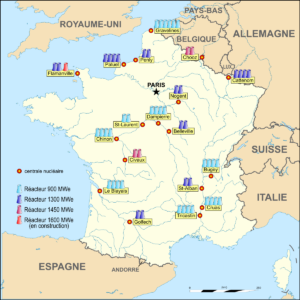
In 2019, the vast majority of the country’s nuclear electricity production (80%) was generated by 4 regions : Auvergne-Rhône-Alpes, Grand Est, Centre Val-de-Loire and Normandy.
In 2018, France’s nuclear fleet was the second largest nuclear fleet in the world, after the United States and ahead of China.
(Source : EDF – Nuclear power in figures)
What are the different types of reactors used in the French nuclear fleet?
Depending on the type of fuel used, nuclear reactors can be classified into 5 main categories:
- the pressurized water reactor (or PWR reactor): all the reactors in France intended to produce electricity are PWRs, with the exception of the Phénix nuclear research reactor, operated by the CEA and EDF and shut down in 2009.
- the boiling water reactor (or BWR): the water is cooled but not pressurized. 22% of the world’s reactors are BWR.
- The heavy water reactor
- Fast neutron reactor (or FNR): the fuel is enriched uranium and plutonium.
- the gas coolant reactor (GCR): helium is the coolant and it powers the turbine.
The challenges of nuclear power in 2022
Despite the dynamism of the sector, the French nuclear fleet is currently facing a complex situation. Indeed, since the end of April 2022, Nearly half of the reactors in the French fleet are shut down (there are only 27 reactors in operation at present). This is an all-time record in the industry.
Most of these suspensions were planned for a long time, as part of maintenance work. This work has been delayed because of Covid and the shutdown of the reactors has, for some, been extended because of anomalies detected (corrosion of the pipes, ageing, technical problems, etc.). A A ten-year inspection, with a complete shutdown of the nuclear reactors, is also necessary to carry out routine checks and to change part of the fuel.
There are therefore a number of uncertainties today regarding the capacity to ensure the production of electricity this winter. The sector has also suffered on numerous occasions from a shortage of qualified talent in certain professions and sectors in tension.
In addition, the share of nuclear power in France in 2021 corresponded to 67% of the country’s total electricity production (this is the lowest rate since 1985).
What are the future plans for the French nuclear fleet?
A large-scale project was announced at the beginning of the year by Emmanuel Macron. Indeed, on February 10, 2022, the Head of State announced his plan to revive civil nuclear power with the aim of Achieving carbon neutrality by 2050. In particular, he announced the construction of a new nuclear fleet consisting of 6 new EPR reactors. It is planned that the construction will start in 2023 and that the park will be commissioned by 2035. These different nuclear facilities will be spread over different nuclear sites in Penly, Gravelines, Bugey or Tricastin.
As part of this project, EDF will open 3,000 new jobs by 2022.
→ To find out more about the subject, see our article: “Spie, EDF, Bouygues, Engie, Orano (ex-Areva): 5 nuclear companies in search of talent“.
In addition, the President of the Republic has launched a call for projects for the construction of 8 additional PR2 vehicles.
Another, less recent, project was launched in 2014 by EDF: the Grand Carénage. This industrial programme aims to renovate and modernise existing nuclear power plants. This project plans to renovate or replace large end-of-life components by 2025, improve the safety of the facilities, the management of radioactive waste, ensure the performance of the reactors’ operations, and extend their lifespan beyond 40 years.
This is in line with the government’s desire to no longer shut down nuclear power plants that are able to generate production after 40 years (after this period, the dismantling of reactors is usually planned – it should be noted that the age of the French nuclear fleet would be on average 34 years). The aim is in particular to respond to The increase in requests and electricity needs. In 2021, The ASN (French Nuclear Safety Authority) has authorised the continuation of the commissioning of the current reactors, which are 40 to 50 years old.
To find out more about the future of nuclear power, consult the SFEN (Société Française d’Energie Nucléaire) study “Scenarios 2050 – Study of the contribution of the French nuclear fleet to the European energy transition”.
Articles récents
 Is the French nuclear industry facing a shortage of talent?
 Here is the number of jobs to be filled in the nuclear industry in France in 2022
 Here are the nuclear professions necessary for the renewal of the sector
 University of Nuclear Professions: A Response to the Workforce Shortage
 EDF’s Excell Plan: excellence, quality and rigour in the nuclear industry
 Nuclear and atomic engineering: profiles that interest the sector