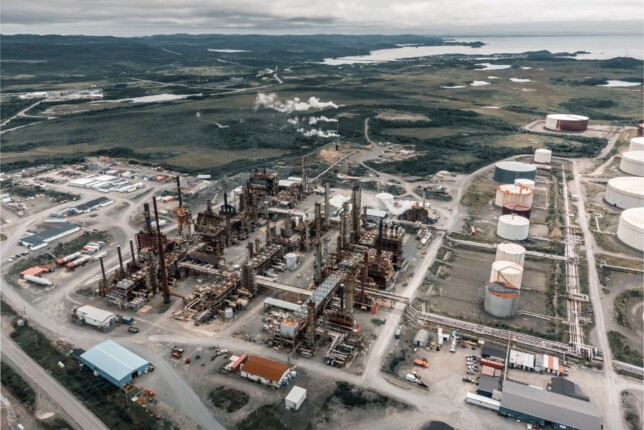
A site that costs significantly more than its twins in the group is never a coincidence. After a split or a change of shareholder, the gap widens quickly, sometimes in just a few months. Faced with this drift, an interim transformation director takes over the site: quantified diagnosis, action plan, execution in the field. Here is how this profile helps an industrial group reduce costs without breaking production.
Summary
- An industrial site under pressure: when costs fall
- A split, a classic trigger for cost
- The case of a chemical site brought back into line with the group’s
- The levers of an interim
- Why industrial groups call on WAYDEN
- FAQ
- Conclusion
- Sources
drift
standards
transformation director
An industrial site under pressure: when costs fall
In a group that manages several sites, cost differences always end up rising. Internal benchmarking identifies the one that produces more expensive than the others. The one whose fixed costs never really go down, the one that doesn’t absorb the load jolts.
The sectoral context does not help. In 2025, the French chemical industry’s production fell by 3.8% in volume compared to 2024. This is shown by INSEE’s macroeconomic indicators for the manufacturing industry. The sector’s added value has followed a similar trend. In a shrinking market, a site that is more expensive than its counterparts quickly becomes a subject that the group can no longer postpone.
If you run this type of site, you know that performance is not just a number on a dashboard. But when the gap has persisted for several years, the group expects a concrete plan, not another explanation. This is precisely when an interim transformation director comes in.
A split, a classic trigger for cost drift
A strategic split changes the situation much more than we imagined at the time of signing it. The site, which belonged to a large group, suddenly loses the shared services: group purchasing, shared maintenance, support functions spread over several factories. Fixed costs remain on site.
The new owner then discovered a cost structure designed for a different context. It was designed for a larger complex than the autonomous site that it must now support. And the sectoral calendar is not in its favour. The European chemical industry has seen 9% of its production capacity closed or announced to close between 2022 and 2025. This trend threatens around 90,000 indirect jobs, according to an analysis by Watts Else published at the end of January 2026. France alone accounts for nearly 3.9 million tonnes of affected capacity.
In this climate, a site that is struggling with its costs no longer has the luxury of waiting several years to recover. The group wants to see a transformation plan initiated before the gap becomes a reason for closure. Our guide to the business turnaround plan details this subject in more detail.
The case of a chemical site brought back into line with the group’s standards
This is exactly the situation experienced by an international chemical group after a strategic split. One of its main French sites, located in the Lyon region, had production costs that were significantly higher than those of the group’s other sites.
However, the site was not badly managed in the strict sense. It simply bore the legacy of an organization designed for a larger whole. The fixed costs remained disproportionate and the management structure had never been reworked since the split. The local teams knew their industrial tool well, but no one had had the mandate or the time to rethink the organization as a whole.
The group has entrusted the management of the transformation to an interim director, with a clear mandate. Reducing fixed costs, modernizing the organization, realigning the site with the group’s standards. All this without ever compromising safety or production continuity. This type of intervention requires the economic performance and operational stability of the site to be held together. Our example of a mission with a player in the chemical industry is a good illustration of this. In an industrial region where WAYDEN has been supporting several groups for a long time, this mandate is part of a continuity of local expertise.
The levers of an interim transformation director
Faced with a cost drift, an interim transformation manager is not satisfied with cutting expenses at random. He structures his intervention around a few levers, chosen according to the initial diagnosis and the real room for manoeuvre of the site.
- The diagnosis of fixed costs, item by item, to identify those that no longer correspond to the real size of the site after the split.
- The renegotiation of supplier and energy contracts, a particularly sensitive item for a chemical site.
- The reorganization of middle management, often inherited from the old structure and poorly sized for a site that is now autonomous.
- The realignment of production processes with the quality and safety standards of the new shareholder group.
- The tighter management of indicators, with regular progress reports to adjust the trajectory without waiting for the end of the mission.
This work is also based on a good knowledge of the sector. Safety and compliance issues weigh on every cost reduction decision. Our article on the issues entrusted to the chemical interim manager details it. A transformation manager who knows these constraints avoids the classic pitfall. Saving money on the wrong job, and weakening the production that he or she must turn around.
Why industrial groups call on WAYDEN
WAYDEN regularly works alongside industrial groups confronted with this type of abuse. The firm relies on a pool of more than 8,000 qualified managers. The profiles generally have 15 to 25 years of experience in site management or industrial transformation.
One point is particularly important in this type of mission: speed. WAYDEN presents candidates within 48 to 72 hours and can deploy a transformation manager on site in less than a week. For a group that discovers the extent of the cost gap after a spin-off, this time changes the trajectory in the first few weeks.
Each mission is monitored by an associate director, who is responsible for the initial framework and progress reports with the group’s management committee. This continuity also reassures the site’s teams, who are often worried when an external manager takes over the management of their transformation. Our division dedicated to industry has other missions of this type, carried out in comparable industrial contexts.
FAQ
How long does an interim transformation director mission last?
The duration varies according to the scope of the plan, but it is generally between six months and one year. The mandate is sometimes extended to accompany the increase in autonomy of the permanent successor.
What is the difference between an interim transformation director and a strategy consultant?
The strategy consultant makes recommendations. The interim transformation director takes over the operational management of the site. He executes the plan himself with the teams in place, until the results are achieved.
Can an interim transformation director intervene without a redundancy plan?
Yes. Cost reduction does not necessarily mean reducing the workforce. Many assignments focus primarily on fixed costs, purchasing, organization and processes.
How does an industrial group choose the right transformation manager profile?
The choice is based on sector experience and the ability to lead an existing team. Knowledge of the site’s regulatory constraints is also important, particularly in classified chemical or industrial environments.
Sources
- INSEE, “Macroeconomic indicators of the manufacturing industry”, published on 21 July 2026: 3.8% decline in the volume of production in the French chemical industry between 2024 and 2025.
- Observatory of the Chemical Industries, “2025 Branch Report: A Portrait of the Chemical Workforce”, updated on 19 January 2026: 229,000 employees and 4,362 companies in the sector, more than half of which are concentrated in three regions.
- Watts Else, “The European chemical industry in full collapse”, published on 29 January 2026: 9% of European production capacity closed or announced to be closed, around 3.9 million tonnes affected in France, electricity costs 2.5 times higher than in the United States.