
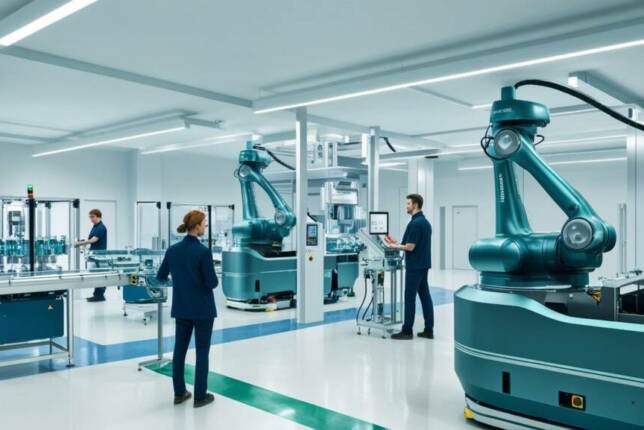
Industry 4.0, smart factory, automation, predictive maintenance… At a time when new technologies are infiltrating all sectors of activity, the industrial sector is no exception. But what are the main technological changes at the moment? And how can you successfully manage such a digital project within your industrial company?
In this article, WAYDEN offers you an overview of the 5 major industrial digital transformations.
Industrial digital transformation: what is it?
Industrial digital transformation refers to the implementation of new technologies in the production and management processes of industrial companies.
In the face of current technological advances and the rise of digitalization, it is now an essential step to preserve its competitiveness, maximize its profitability and boost its performance as an industry player.
5 examples of industrial digital transformations
Here are 5 examples of digital transformations in industry:
-
The Smart Factory
The smart factory is now an innovative solution, essential in the transition to Industry 4.0.
The aim is to transform its industrial production site into a self-managed, digitalised and networked environment. Thanks to the continuous sharing of data, the installation of machines and connected logistics systems, the smart factory manages the production processes almost autonomously, with almost no human intervention. Connected factories bring together a wide range of technologies: artificial intelligence, Big Data, the Internet of Things (IoT), digital twins, autonomous machines, cloud computing, etc.
This digital transformation is intended to maximize productivity, ensure compliance with quality standards, save time, reduce costs and lead times.
-
Optimizing industrial processes with AI
More and more industrial companies (agri-food, aeronautics, nuclear, etc.) are now using artificial intelligence tools to optimize and accelerate their processes.
AI is a set of technologies that can mimic certain human intelligence abilities, such as expression, reasoning, and execution. Among the technologies that use artificial intelligence, we can mention robotics, sensors, connected objects…
These “thinking machines” not only speed up the entire production process, but also maximize productivity, reduce errors and increase the level of production quality. For the industrial company, this translates into better profitability, increased customer satisfaction, reduced costs and lead times, etc. AI tools are also capable of facilitating the rationalization of resources, decision-making, anticipating failures, etc.
-
Predictive maintenance tools
Many industry players have also started to implement predictive maintenance tools, capable of monitoring the status of equipment and machines in real time. Thanks to the collection and analysis of data, these technologies are able to anticipate potential failures upstream. For the industrial company, it is an excellent way to extend the life of its equipment and reduce the costs related to the repair and maintenance of its installations. It also strengthens on-site security and ensures operational continuity through a reduction in the number of disruptions in the supply chain.
-
Automating supply chain management
Another prominent digital transformation in the industrial sector is the automation of production management. This consists of using new technologies throughout the supply chain to automate operational processes. To do this, many technologies can be used, such as: artificial intelligence; The robotic process automation , automatic data analysis, PLCs, measurement sensors, communication buses, etc. Advanced production software such as the WMS (Warehouse Management System) is also one of the essential tools to implement to automate supply chain management.
In addition to increasing operational efficiency, this automation approach also makes it possible to reduce production times, improve product quality and accuracy, optimize inventory management, increase production rate, etc.
-
The implementation of digital twins in design and industrial production
Digital twins , are dynamic virtual reproductions of physical equipment, systems and products. They make it possible to carry out simulations and optimize, in real time, industrial performance. Digital twins connect data from IoT sensors, providing a complete view of all industrial processes.
The implementation of these technological innovations allows the company to test, from the design phase, different scenarios, while preserving the continuity of production. It is also a great way to anticipate possible defects and problems during the prototyping phase. As a result, development costs are reduced, product quality is improved, and time-to-market is greatly shortened.
How to succeed in a digital transformation in industry?
As in all industries, the success of a digital transformation in industry depends on many factors and requires a structured and methodological approach, broken down into several key steps:
-
Defining the objectives of the industrial digital transformation
First and foremost, it is imperative to clarify the SMART goals as well as the strategic vision for this digital transformation. Is the goal to improve productivity? To reduce costs? Increase customer satisfaction? To increase performance? … Identifying the strategic objectives with precision will make it possible to clarify the roadmap and the actions to be deployed.
-
Carry out a diagnosis of the existing situation
Before activating the digital transformation phase, it is also essential to carry out a complete diagnosis of the existing situation: what are the current processes, methods and tools? What are the weak points and opportunities for improvement? What are the priority corrective areas?… This preliminary inventory will make it possible to precisely target the real needs and the appropriate solutions.
-
Identify the right technologies
As mentioned above, a wide range of technologies can be involved in the industrial digital transformation: the Internet of Things, artificial intelligence, digital twins, industrial robots, PLCs, virtual or augmented reality, cloud computing, 3D printing, smart sensors, blockchain, etc.
It is therefore important to take the time to identify solutions that are aligned with the needs of the company, its sector of activity and the objectives set.
-
Train, involve and acculturate operational teams
Any digital transformation project raises significant technical challenges, but also large-scale human challenges. To overcome the resistance to change inherent in this type of project, it is therefore essential to demonstrate close and transparent communication at every stage of the project. This also involves an acculturation and training process, to enable the field teams to appropriate the new tools in a fluid manner.
In addition, it is vital to involve all stakeholders throughout the lifecycle of the digital transformation project to strengthen their buy-in and commitment.
-
Making digital transformation part of a continuous improvement approach
Finally, it is important to remember that a digital transformation project is intended to be a long-term process, in a continuous improvement process. This implies first of all identifying and implementing performance indicators (KPIs – Key Performance Indicators), to measure the results of the transformation. Here are a few examples: production rate, scrap rate, manufacturing times, operational costs, savings made, downtime…
Depending on the results observed, the company will be able to identify areas for improvement and deploy the necessary corrective actions to achieve the strategic objectives set.
As an industry player, would you like to be supported in the management of your industrial digital transformation? WAYDEN identifies and assigns an interim manager in the industry for you, an expert in digital transformations. With 15 to 25 years of experience, this natural leader is experienced in the deployment of large-scale digital projects with strategic challenges. He supports you at every stage of your transformation, from the analysis of the existing situation to the implementation of technological solutions.
Articles récents
 Smart Factory: the future of industry is digital and smart
 Feedback from an agile coach in the context of a digital transformation
 Artificial intelligence in industry: what are the challenges?
 The CFO: a key role in the company’s digital transformation
 What is omnichannel business transformation?
 ERP core model: how to successfully deploy it?