
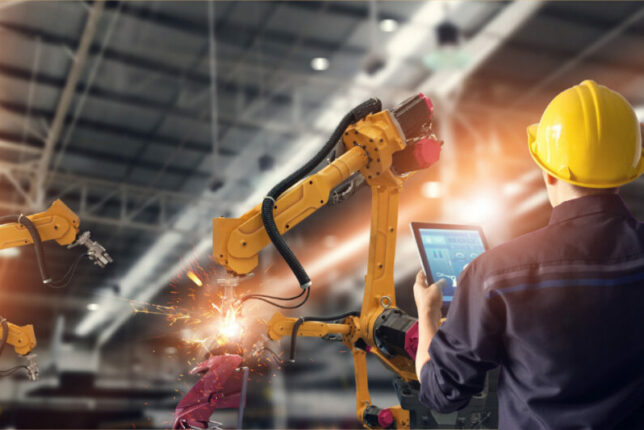
While the health crisis has revealed the limits of the traditional supply chain model, it has also helped accelerate digital transformation and process automation across many industries. We take stock of the challenges and benefits of industrial automation, at the heart of tomorrow’s industry.
What is automation in industry?
Industrial automation refers to the use of new technologies, without human intervention, in the production chain.
In other words, it is the use of machines, technology and digital tools to optimise industrial processes.
Here are some examples of methods and tools used in industry automation:
- AI (artificial intelligence);
- RPA (robotic process automation );
- 2D or 3D vision;
- automatic data analysis;
- the robotization of production;
- automatons;
- measurement sensors;
- communication buses…
While industrial automation has been booming in recent years, this phenomenon is far from new, dating back to the 1950s. This concept comes from the desire of the players in the Increase plant productivity and manufacturing efficiency.
Increasingly advanced technological advances now allow us to facilitate industrial automation , which would be, for many, a pillar of the industry of the future, or Industry 4.0.
What are the challenges of automation in industry?
Industrial automation responds to multiple challenges, at the same time economic, social, health and environmental.
Here are some tangible benefits of automation in industry:
- Acceleration and optimization of the manufacturing cycle;
- increasing the rate of production;
- Increased productivity, range, and performance .
- greater accuracy and guaranteed final quality;
- Cost reduction and a quick return on investment;
- greater flexibility;
- adaptability and resilience in the face of external hazards and crisis management ;
- a strengthening of competitiveness;
- strict adherence to norms and quality standards ;
- a reduction in the risk of errors;
- better waste management and reduced waste;
- inventory optimization;
- a reduction in occupational risks;
- improved working conditions;
- an economy of human and energy resources;
- a reduction in production times…
Industrial automation makes it possible to entrust repetitive, arduous, or even dangerous tasks for humans, to machines and thus to reserve human expertise for high value-added missions.
How to successfully automate your industrial activity?
To successfully implement automation in your industrial activity, it is first and foremost necessary to understand that the objective is not to completely replace human intervention, but to merge the expertise and judgment of employees with the performance of robotics and digital.
As such, strong management remains the keystone of effective automation. Indeed, it is necessary to be able to reconcile several different fields of intervention and expertise (electronics, mechanics, information technology, digital, etc.). In addition, Automation often involves facing certain resistance to change (the fear of job loss, of a dehumanization of exchanges, etc.).
It is also crucial to surround yourself with various trusted partners: a design office specializing in automated systems, reliable suppliers or a supply chain interim manager to ensure the proper implementation of this change management, to train the teams and to overcome any resistance.
Articles récents
 Feedback from an agile coach in the context of a digital transformation
 Artificial intelligence in industry: what are the challenges?
 The CFO: a key role in the company’s digital transformation
 What is omnichannel business transformation?
 Corporate financial transformation: what changes for the finance function?
 Artificial Intelligence in the Food and Beverage Sector: 5 Issues and Challenges