
In France, an accident at work with lost time occurs almost every minute, according to the latest available figures. In the food industry, the speed of the lines and handling make this risk even more concrete. A health and safety interim manager can reverse the trend in a few months.
Contents
- A national context that leaves no choice
- Why the agri-food industry concentrates particular
- What a health and safety
- The case of a multi-site
- Why entrust this mission to WAYDEN
- FAQ
- Conclusion
- Sources
risks
interim manager does
agri-food group
A national context that leaves no choice
You may have the impression that accidentology is declining, year after year, driven by decades of prevention. Recent reality qualifies this observation. In 2025, 549,614 lost-time accidents were recorded in France, according to DAE-Pro, or about one accident per minute.
The problem? Nearly 35% of these accidents concern employees with less than three years of seniority. Manual trades, which are very present in industry, account for about 60% of cases according to the same source.
Recognised occupational diseases also continue to rise, largely driven by musculoskeletal disorders.
Faced with these figures, prevention can no longer remain a secondary issue carried out by a single isolated person.
According to INFORISQUE, 555,803 lost-time accidents were recorded in 2023, a figure that has remained almost stable since. Construction, transport and health remain the most exposed sectors, but industry is never far behind.
Why the agri-food industry concentrates particular risks
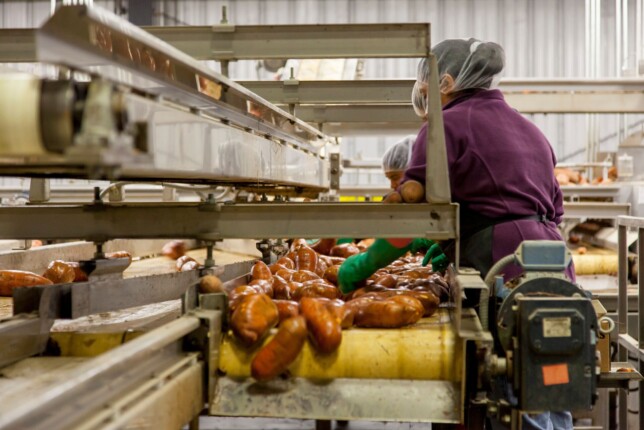
An agri-food site has several risk profiles in a single place. Pedestrian flows constantly cross handling equipment, on often wet or slippery ground.
The machines run at high speed, with teams that alternate shifts according to production needs. Confined environments, cold rooms or tanks, add an extra dimension to the necessary vigilance.
This combination of factors explains a striking figure. In the agri-food industry, 97% of recognised occupational diseases are musculoskeletal disorders, according to the Health Insurance. Their cost exceeds €77 million in employer contributions each year, with more than 930,000 working days lost.
Behind these figures, there are tired teams and incessant replacements. Production is running at a slow pace, without always understanding the root cause.
A site that takes over the operation of an existing plant, for example after a takeover or delegation, also inherits the habits of the former operator. Aligning these practices with new standards takes time and a dedicated method.
This is particularly true for groups that grow quickly, through external growth. Each site acquired arrives with its own culture, its own reflexes and sometimes its own blind spots in terms of prevention.
What a health and safety interim manager does
As a manager, you don’t expect another report. You expect the accident curve to reverse, and for your teams to regain confidence in their work tool.
Field diagnosis above all
The interim manager starts by going to see the workstations and listen to the operators. He then cross-references the accident data with what is actually happening on the lines.
A multi-year roadmap
He then builds a prioritized action plan, with clear priorities and indicators monitored over time. A “safety first” roadmap is never just a simple list of instructions posted in the break room.
The involvement of local management
The Occupational Health Plan reminds us of a key point, according to the ANDRH. Safety only becomes a real corporate value when management and managers are concretely involved. An interim manager carries this change on a daily basis, with the team leaders.
This approach requires consistency. The results are measured over several months, rarely in a few weeks, but the trajectory is reversed as soon as the teams see the first concrete actions.
Monitoring indicators that speak to the field
An interim manager avoids overly theoretical dashboards. He favours simple indicators, understood by the operators themselves. The number of near-misses reported or the time it takes to process an alert are part of this.
The case of a multi-site agri-food group
A leading family-owned agri-food group has integrated an environmental services structure. It quickly noticed a clear gap between its safety standards and the practices observed in the field.
The scope concerned covered production, logistics and maintenance, on several sites with a high risk profile. Pedestrian-machine flows, high-speed machines, confined environments and musculoskeletal disorders coexisted on a daily basis.
This combination made management particularly demanding for a team already under pressure, without a stable QHSE department to arbitrate priorities.
An interim manager made the diagnosis, defined the priorities and built a multi-year roadmap internally called “Safety first”. This mission took place during the absence of the group’s QHSE-CSR director, without any break in the management of prevention.
WAYDEN also closely monitors the changes in this sector, in particular through artificial intelligence applied to the agri-food industry. High-speed industrial sectors have every interest in relying on external expertise. A transformation left to its own devices would often take years.
Why entrust this mission to WAYDEN
Over wayden.fr, the firm mobilizes a pool of 8,000 qualified managers. The profiles are presented in 48 to 72 hours, for a possible start of the mission in less than a week.
Our health and safety interim managers have an average of 15 to 25 years of experience in QHSE or industrial management functions. This field experience makes all the difference when it comes to convincing teams that are still suspicious.
Each mission remains monitored by an associate director, from the initial diagnosis to the handover to the future manager. As our feedback on plant managers on transition missions shows, this continuity of monitoring largely determines the success of a safety project.
To broaden the perspective, our article on HR risk management in companies shows how the QHSE function is articulated with other organizational risks. Our industrial customers are particularly exposed to this.
FAQ
How long does it take to reduce the accident rate of a site?
The first results often appear after three to six months. Establishing a sustainable safety culture generally requires a roadmap over twelve to twenty-four months.
Does a health and safety interim manager replace the CSE or the prevention department?
No. It reinforces and structures the existing system, in conjunction with the CSE, occupational medicine and the prevention teams already in place on the site.
Does this mission only concern large industrial groups?
No. Mid-market companies also use it, especially after an acquisition or strong growth, to align their practices.
What happens at the end of the transition mission?
The interim manager sends a documented roadmap to the future permanent QHSE manager, with the indicators monitored and the actions already taken.
Sources
- DAE-Pro, “Accidents at work in France: 549,614 cases with lost time in 2025”, published on 26 February 2026: number of accidents with lost time and distribution by seniority and type of job.
- Ameli.fr, “Musculoskeletal disorders in the agri-food industry”, published on 11 March 2026: share of MSDs in occupational diseases in the sector and associated cost.
- ANDRH, “World Day for Safety and Health at Work 2025”, published on 28 April 2025: role of local management in safety culture.
- INFORISQUE, “Occupational accidents in 2025: why prevention remains more vital than ever”, published on 19 September 2025: assessment of accidents and most exposed sectors.
Articles récents
 The CFO job in 5 transformation projects to manage in a company
 Interim manager and safety culture: successfully taking over a site under a public service delegation
 Interim accounting reinforcement: absorbing a multi-entity banking migration
 What is omnichannel business transformation?
 Interim CRO (Chief Revenue Officer): example of an assignment in the automotive sector
 New management methods: how are interim managers adapting?