

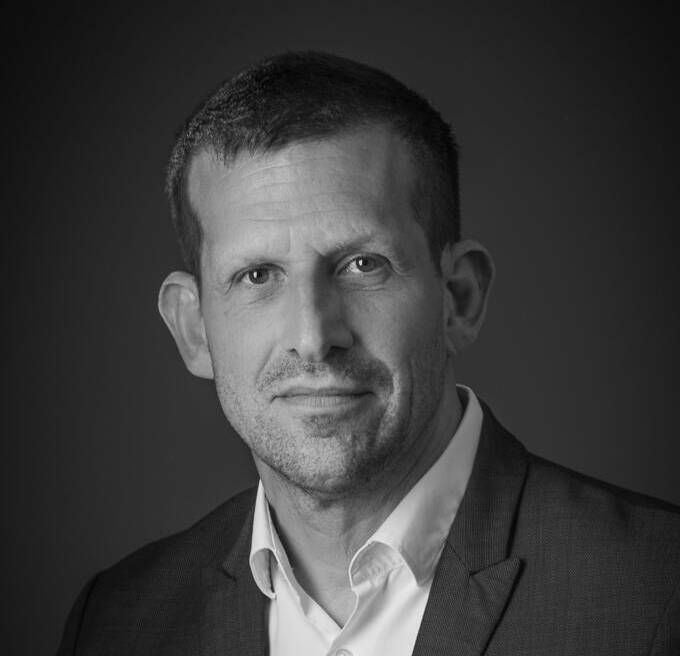
Vincent Potel is the Interim Chief Executive Officer. For more than 10 years, he has been involved in recovery and restructuring missions. He works with start-ups or subsidiaries of large groups, in various sectors of activity, throughout France.
You have worked on missions involving artificial intelligence. Could you give us a concrete example?
I will give you two examples.
Currently, I am the Managing Director of the digital subsidiary of a pharmaceutical distributor. We had a problem with the processing of flows on a call center, and we used an AI-based solution to record and transcribe the calls, in order to write a report. With the creation of this database, we are feeding a Frequently Asked Questions to improve the quality of customer service.
I also worked for a start-up specialising in timelapse. When I arrived, the company had only one historical activity, communication on construction sites. During my mission, we defined three strategic areas of activity: communication, security, and on-site surveillance. We used artificial intelligence to analyze photos taken on construction sites and identify whether or not people were wearing hard hats. We have also used AI and the Internet of Things to monitor sites and analyse the quality of the waste deposited, as part of the implementation of the AGEC law.
In your opinion, has AI been adopted in companies?
I think we are in a similar situation to that of the Internet. Companies are starting to understand the importance of AI, but it takes time, the acquisition of skills.
Companies must be ready to question themselves and understand the impact of this new technology. It is crucial to form multidisciplinary teams at different hierarchical levels to thoroughly analyze the areas where AI can add value. It’s not just a matter of training on tools like GPT, but of establishing a strategic plan for 5 to 10 years.
Standardised sectors where there are control procedures, such as the supply chain and production, but also finance and human resources, will be strongly impacted. AI will also play a major role in customer relations and will be used to optimize companies’ internal processes.
Do you have any examples of companies that have been able to leverage AI to create a competitive advantage?
It’s too early to say. There are a lot of companies that use AI, but it’s important to remember that AI is a tool and not an end in itself. You need a company with a clear value creation for the tool to be useful.
We are in a phase where the market is saturated with micro-solutions. There is a profusion of tools, which are not always well used, especially in the field of social networks. People sometimes think that they can just press a button and that everything will be fine, which is far from the case. There is a real need for concentration and analysis of the appropriate tools.
How do you imagine the evolution of AI?
I think AI is currently at a similar stage to the internet in its early days. There were a multitude of options and information, but it was quite chaotic and difficult to navigate. With time and widespread adoption, things have become more structured and qualitative.
I think it’s a natural cycle in any new market. First there is an explosion phase with many new players and solutions, then a crisis that leads to consolidation and the emergence of a few major players. This is what has happened in telecommunications, and I think it will happen in AI as well.
I don’t believe in an AI revolution that would surpass humans. I think the first step will be consolidation and wider mainstream adoption. AI will continue to develop at a very rapid pace, and it is crucial to remain agile and keep up with these developments closely. The COVID-19 pandemic has significantly accelerated the adoption of technologies like video conferencing and there is always a learning curve needed to adopt new technologies. I can’t predict how AI will evolve, but how it will be used and how it impacts our daily lives will certainly be key things to watch.
Which countries are leading the way in AI?
The United States or China are often cited, and it is true that they are one step ahead in certain areas such as e-commerce. However, I think the future is in India. They have a culture of learning in English, a large number of engineers, and an approach that could lead them to make great strides in the field of AI. As for France, there are some great initiatives but we are not in the leading group.
On the other hand, we have world-famous talents, I’m thinking in particular of Luc Julia. He’s a reference in the field and he brought a very relevant perspective on artificial intelligence, or rather machine learning, as he prefers to call it. He points out that the machine learns from the data we provide it, and it is this learning process that creates what we call artificial intelligence.
With AI comes the question of ethics. What do you think?
We must not blindly believe everything we find on the internet or what AI offers us. You have to take a critical approach and ask yourself where the information comes from and if it is reliable. As with newspapers, there are different biases and orientations, and it’s essential to be aware of them.
We must also ensure that ethics are integrated from the beginning in the development of AI tools. And finally, it’s important to stay agile and be ready to adapt to the rapid changes that are coming in this area.
The Bletchey Park conference illustrates that we have become aware that we must regulate the development and use of artificial intelligence before it is too late.
Articles récents
 Knowing how to bounce back after 45 years, book written by Benoît Durand-Tisnès
 WAYDEN confirms its approach to excellence and continuous improvement
 Interview with Christophe Caupenne – “Even in the face of uncertainty, there is a solution”
 WAYDEN in the New Factory
 Interview with Benoît Durand-Tisnès and Stéphanie Guernalec – BSmart TV
 WAYDEN participates in Talents!, an event for HR Decision-Makers