
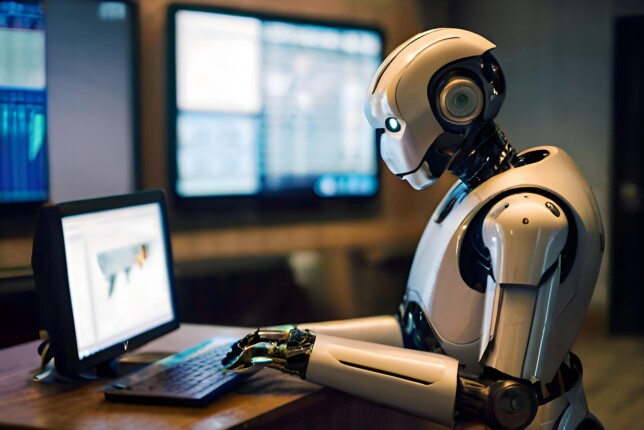
Why integrate artificial intelligence into your company?
The adoption of artificial intelligence in business is a powerful lever for competitiveness, performance and profitability in many respects for organizations of all sizes and in all sectors. Well implemented and used, these new technologies make it possible to speed up processes, automate time-consuming tasks and maximize the performance of all business functions.
According to a joint study by MIT and Stanford University, 63% of companies notice a decrease in repetitive tasks as well as an increase in productivity of an average of 14% following the adoption of AI. Companies that have integrated AI also benefit from a significant improvement in customer relations (+58%).
In addition, 87% of companies are seeing their teams be more responsive
(Source: Francenum.gouv) following the implementation of AI technologies in their company.
10 Examples of Strategic Use of AI in Business
Data analysis, process optimization, improvement of the customer experience or decision support… Here are 10 examples of the strategic use of artificial intelligence in business.
-
Market analysis
Artificial intelligence is transforming market analysis by cross-referencing customer data, sector studies, consumer trends and signals from the web in real time. This 360° view makes it possible to anticipate developments, detect growth opportunities early and adjust business strategies with the agility needed to stay ahead of the competition. It also helps refine targeting, better understand emerging customer expectations, and secure decision-making in increasingly volatile environments.
-
Cybersecurity and the fight against fraud
AI is revolutionizing cybersecurity By detecting suspicious behavior, intrusion attempts and fraud patterns invisible to traditional methods in real time. By analyzing massive volumes of data, it identifies cyber anomalies before they cause damage. With continuous learning, systems automatically adapt to new threats and refine their accuracy as attacks progress.
-
Simulation and modeling to anticipate changes
Artificial intelligence tools also make it possible to simulate complex scenarios and model different hypotheses before making strategic decisions. By relying on historical and real-time data, AI can anticipate the impact of operational choices, Financial or organizational, such as a change in price, a change in demand or a reorganization of resources. AI is thus becoming a powerful tool for management and anticipation for companies.
-
Real-time decision-making
In addition, it radically transforms the speed and quality of strategic decisions. By instantly cross-referencing and analysing data from multiple sources (sales, stocks, customer behaviour, market trends, etc.), it offers managers a consolidated and up-to-date view of their business. In a volatile economic environment, this real-time decision-making is a decisive competitive advantage. AI does not replace human judgment, but it illuminates it with a precision and speed that cannot be achieved manually.
-
Predictive analytics
Predictive analytics is one of the most strategic applications of artificial intelligence. By cross-referencing historical, behavioral, and contextual data, AI anticipates trends, risks, and opportunities with an accuracy that would otherwise be unattainable. In concrete terms, it makes it possible, for example, to predict the evolution of sales, to anticipate stock shortages, to detect the risks of customer churn (attrition) or identify operational failures before they occur.
-
Detection of accounting anomalies
The field of accounting is also revolutionized by artificial intelligence, which automatically detects anomalies, data entry errors, or suspicious transactions and inconsistencies in financial flows. Where manual auditing is limited to error-prone sample checks, AI analyzes the entire data in real time. In practice, it identifies duplicate invoices, unusual discrepancies between budgets and expenses, internal fraud attempts or transactions that do not comply with procedures.
-
Filing administrative documents
Invoices, contracts, expense reports, payslips: every day, hundreds of documents pass through the company. Thanks to optical character recognition (OCR) and natural language processing, AI identifies the nature of each document, extracts key information (dates, amounts, references, etc.) and classifies them in the right directories, according to predefined rules. It also detects missing or incomplete documents, making administrative follow-up easier.
-
Predictive maintenance of equipment
In industry, production downtime for preventive maintenance represents a significant cost. By combining IoT sensors and machine learning, AI continuously monitors the status of industrial equipment. Thus, by intervening at the optimal time, unplanned downtime is drastically reduced, while productivity and the lifespan of the equipment increase significantly.
-
Marketing and improving the customer experience
Targeted recommendations, tailor-made content, support via chatbots available continuously… With behavioral analysis and machine learning algorithms, AI adapts customer journeys in real time. In addition, by using the data collected, the teams Marketing companies design more effective campaigns, optimize conversion rates, and sustainably increase customer satisfaction and retention.
-
Virtual assistants
Intelligent virtual assistants are establishing themselves as true digital employees within companies. Integrated with collaborative tools, they automate administrative tasks, facilitate meeting scheduling and answer team questions instantly. They thus free up time for the teams, which can be allocated to higher value-added missions. In this way, they not only improve the operational efficiency of employees, but also their well-being at work.
Integrating artificial intelligence into the company with an interim manager
The adoption of artificial intelligence in companies involves a profound transformation of processes, working methods, governance, etc. This digital transition also comes with many challenges, not only technical, but also human.
To support this change management, the interim manager is a key ally. Thanks to his unparalleled know-how and his in-depth know-how, he helps the company to identify use cases, choose the best tools, train employees to use them and to solve their problems. resistance to change.
At WAYDEN, we can identify and mobilize, within our vast pool of experienced professionals, an AI interim manager with 15 to 25 years of experience in change management and digital transformation. Throughout his mission, which lasted 6 to 18 months, it helps you structure, deploy and implement these new technologies internally in an efficient, secure and sustainable way.
Articles récents
 Oracle Finance: 5 missions of an operational consultant
 What are the different types of management?
 IFRS & IAS: 10 Differences in Finance & Accounting
 CSRD audit: how does the assessment and diagnosis work for a company?
 SOX compliance: checklist, law, internal control…
 CAIO (Chief Artificial Intelligence Officer): a new tech function in conjunction with the IT department