Lessons from Christophe Caupenne, a specialist in confessions
Now an expert in negotiation and crisis management, Christophe Caupenne has spent more than 30 years in the judicial police, in criminal repression and banditry brigades. In the 2000s, he was appointed Commander of the RAID, an elite unit of the French National Police dedicated to Research, Assistance, Intervention and Deterrence. During these twelve years, Christophe Caupenne established himself as the specialist in confessions. In 2010, he published a book entitled Negotiator at the RAID, who addresses an essential aspect of this profession: the place of intuition in decision-making.
When he took over as head of the RAID in February 2000, the General Directorate of the Police aimed to bring 20% of cases to a successful conclusion through negotiation. While this figure may seem low at first glance, it can be explained by the fact that the negotiation is the last operational intention of a process that, until now, has failed.
When he arrived, a group of negotiators already existed, but Christophe Caupenne noticed that no knowledge in the matter had been formalised. However, according to him, knowing humans in detail, finding, behind all the weak signals, elements of truth, and encouraging emotional outpouring, cannot be invented. It is a demanding profession that requires a proven set of tools to ensure peaceful resolutions.
Following this intuition, Christophe Caupenne and his teams began to gather a wealth of knowledge from medical faculties to refine their mental expertise, from the FBI Academy in the USA to draw inspiration from their teaching, and from foreign units to understand negotiation beyond French borders. From these explorations, they come back with tips that they formalize internally to professionalize their approaches. Christophe Caupenne even decided to go further by creating a Bac+3 and Bac+5 recognized in the national directory of professional certifications to train for the profession of Crisis Negotiator.
After 12 years of good and loyal service and more than 350 operations, Christophe Caupenne’s intuition is crowned with a resolution rate of… 80% !
The pitfalls of management
From this career in the judicial police, Christophe Caupenne has drawn lessons that can be transposed to management, which he is working to disseminate through his eponymous consulting agency, created in 2011. When WAYDEN invited him in June 2019 to speak to his clients and interim managers, the former commander of the RAID was pleased to share some of them with us, taking the precaution of reminding us of the traps we are too often used to falling into.
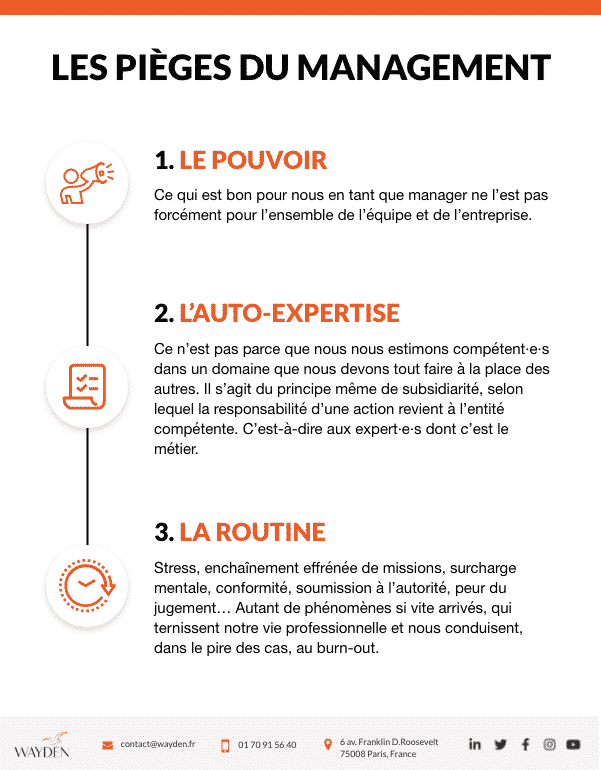
Trap 1. Power
What is good for us as managers is not necessarily good for the whole team and the company.
Trap 2. Self-expertise
Just because we consider ourselves competent in one area does not mean that we should do everything for others. This is the very principle of subsidiarity, according to which the responsibility for an action lies with the competent entity. That is to say, the experts whose job it is.
Trap 3. Routine
Stress, frantic sequence of missions, mental overload, conformity, submission to authority, fear of judgment… So many phenomena that happen so quickly, which tarnish our professional lives and lead us, in the worst case, to burnout.
Faced with these everyday traps, Christophe Caupenne evokes powerful shields closely linked to intuition and common sense.
First of all, trust. The one we give to our teams, to ourselves, but also to our collective ability to change rules and processes. From this trust, stems the need, as we have just seen, to delegate in order to free oneself from a host of operational difficulties and thus, to gain height. But to delegate, consensus is key. From the preparatory phase of a mission, we must know how to let each member of our teams speak so that they can freely express their grievances, reservations and disagreements. Only then can the decision be made.
Then, you have to accept that everything doesn’t go as planned. If there is a mistake, let us instead ask ourselves what lesson to learn from it and position ourselves as the optimist who sees an opportunity in every difficulty, to quote Winston Churchill. Above all, let’s remember that there is no such thing as absolute failure, it’s a question of state of mind.
The Catalysts of Intuition
So, how can we find the accuracy of our intuition?
Christophe Caupenne advises us to implement, every day of our lives, two acronyms that are dear to him:
The BIC
- Benevolence: wishing good to our teams, our hierarchy and our customers in order to engage in reciprocity, a driver of success and efficiency
- Integrity: not to make mistakes of honesty with our teams
- Ability: reassure them that we are the person for the job
The 3Ps
- Preparation: take the time to prepare the ground with our teams to give us confidence in the future
- Progression: understanding that there are steps to take before reaching the end result
- Pedagogy: learning to get involved with subtlety and pugnacity with our teams to transmit concepts and knowledge.
Let us entrust the last word of this article to Benjamin Franklin who, already in his time, had grasped the importance of inclusivity: “You tell me, I forget. You teach me, I remember. You involve me, I learn. »